The emotional seasons of motherhood: The survival years—infants + babies
Mothering feels disorienting from the beginning. Filled with disillusionment. Identity shifts. But no one ever talks about how every stage has a completely different demand.
The survival years/ nesting years—Infants +babies
The touched-out years/snack bitch era—Infants + toddlers
The whiplash years/tiny dictator years—Toddlers + school aged kids
The invisible load years—preschool + elementary age
The stretching years—school-age + middle school
The letting go years/releasing years—High school + teenagers
The rebuilding years—launching children/empty next transition
Each stage has its own: common nervous system responses, marriage impacts, faith struggles, identity shifts, and trauma triggers.
Hopefully I can provide you with practical coping skills and encouragement for each stage as we together support our child’s secure attachment, ability to co-regulate, form his/her identity, differentiate and then launch and transition to adulthood.
Only with motherhood do we expect women to go through an intense physical experience for 24 to 48 to 72 hours, sometimes ending in surgery and then expect them to start parenting around the clock afterwards and function. Mothers are the strongest people I know.
Cute baby finally arrives. Mom runs on adrenaline for next 8-24 hours (the amount of adrenaline available decreases with subsequent children). Life becomes a whirlwind. This is the culmination of a long uncomfortable pregnancy.
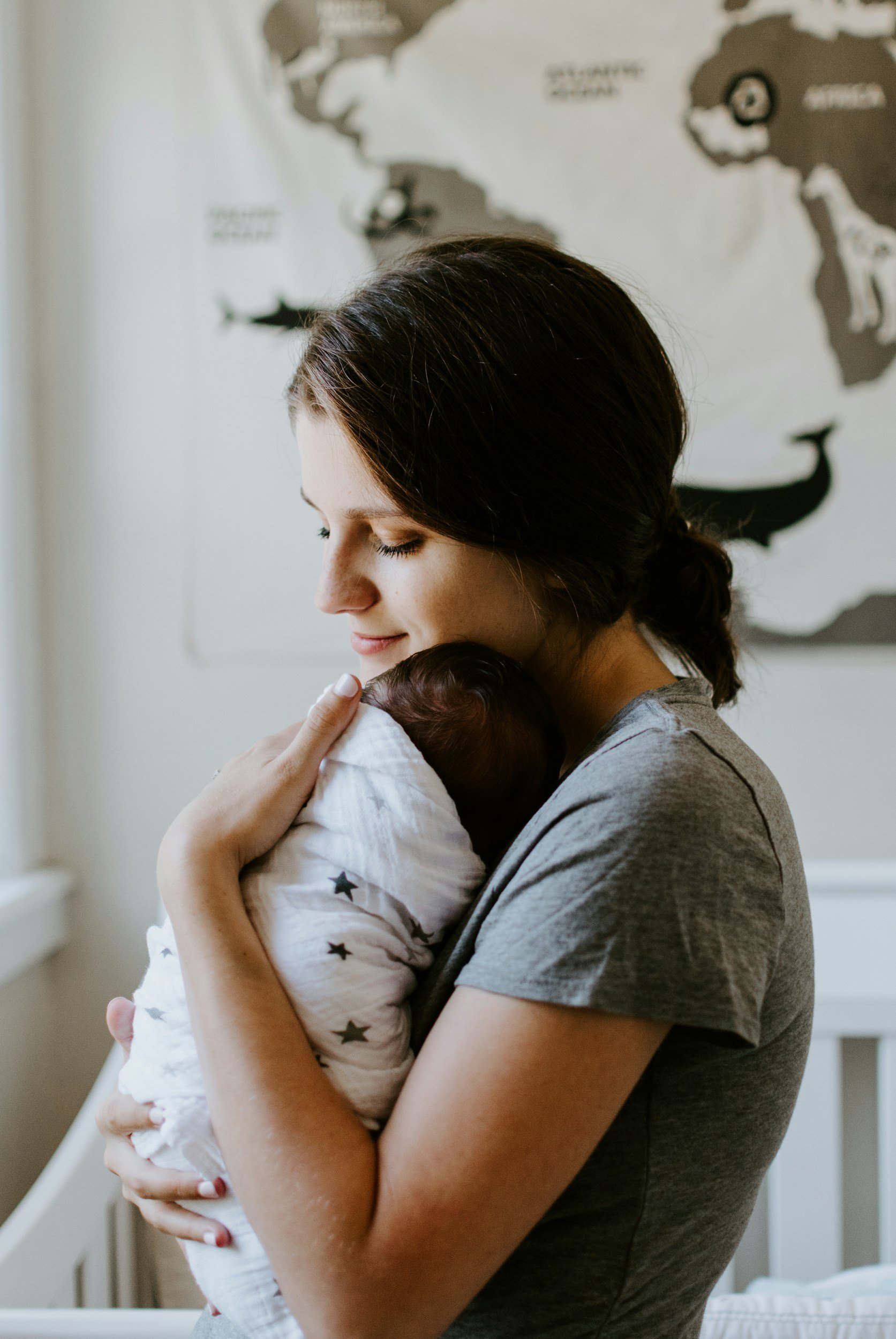
The hope and dream of this child is here.
What happens when the adrenaline wears out? The baby didn’t do anything wrong. She is learning to eat, sleep, just wants comfort from mama. You (mom) start to feel feelings that you never imagined would occur as you dreamed about motherhood. Every mother wants to do right by their child and be a “good enough,” maybe even a perfect Mom. Visitors to the hospital room or to your home feel entitled to hold and dote on this new baby human and all you want to do is protect her. All you want to do and keep her safe. You are trying to be the perfect Mom. It may take days for you to start to recognize your frustration towards your partner, this is what you wanted, maybe even your frustration toward your sweet baby (who didn’t do anything wrong.) So you do your best to hold the feelings inside. That does not serve you. At the very least, holding your feelings inside without a place to untangle and process leads to post-partum baby blues (common in 85% of mothers and resolves in 2 weeks) or post-partum depression or anxiety (1 in 5 women).
Mothering feels disorienting from the beginning. Filled with disillusionment. There is a version of motherhood most women expect; the peaceful baby snuggles, the glowing bonding moments, the overwhelming gratitude. Those moments absolutely exist and how could a mother possibly prepare herself for: the loneliness, the exhaustion, the identity shift, the mental overload, the constant responsibility, the feeling that your body, mind and nervous system no longer belong to you.
In my years of sitting with mothers as their therapist, I often wish they heard this more clearly: You can love your baby deeply and still struggle in this season. Those two truths can co-exist. Honoring your emotions in the midst of this survival season is going make you a better Mom as it will allow you to connect to yourself and your baby. And the irony is, sometimes you will need to set your emotions aside and function for this little one. This season is HARD.

The survival years about more than sleep deprivation.
People often minimize the newborn stage to simply “being tired.” But mothers are carrying far more than interrupted sleep. Mothers are: healing physically, regulating a tiny human constantly, adjusting hormonally, managing invisible labor, navigating relationship changes, mourning independence, and learning entirely new responsibilities overnight. And most are doing it with very little support. Many women enter motherhood believing exhaustion means they are doing something wrong, but in reality, many are operating under impossible expectations.
Humans Were Never Meant to Mother Alone
One of the hardest realities of modern motherhood is this: women are often raising children in isolation while being expected to function as though they still have a village. Instagram is NOT reality. If that mother looks like she has it all together, believe me she does not. You do not need to function perfectly without support. Many mothers spend entire days: alone with children, overstimulated, emotionally touched out, mentally overloaded, and disconnected from meaningful adult support. And then wonder why they feel anxious, irritable, numb, or overwhelmed. The problem is not always that mothers are failing. Sometimes the problem is that mothers are unsupported.
Mama, you need to get out of the house. It is hard to see that you need it because you are in survival mode, but believe me, you do. Sure, you may think, “easier said than done.” Sometimes the mental gymnastics required to make this happen feel like more trouble than it’s worth. But believe me, you need it. My firstborn arrived in January, there was snow, and my husband and I were worried about me slipping and falling with baby in my arms. I will forever describe that season as having cabin fever to those I am uncomfortable admitting it was truly post-partum depression. I didn’t get outside until weeks after my daughter’s birth, and not consistently for almost a month. My second was far easier, both because I understand the realities of all that would be required of me as the mother of this infant, and because he was born in June. I got outside on day 3. Keep the expectation low. Just get out of the house. Drive to a park and walk to a bench with your baby in the car seat (and don’t take her out). Go to your backyard and sit in the sun or just breath in the fresh air. If your partner is around, have him or her give you some uninterrupted time. Start small and the outings will get easier. Maybe try a grocery order pick up. Take out the trash. Go to the beach. Whatever it is that you are craving, go it. You need it as much as your baby does. If you need help to get your baby in the car seat, ask for it. If you need someone to watch the baby ask for it. Start with 10 minutes and maybe get to 2 hours to yourself. The people around you will adjust and they will learn to handle this baby while you get the time you so desperately need.
The Identity Shift No One Talks About
Becoming a mother changes everything. Your schedule changes. Your body changes. Your relationships change. Your freedom changes. Even your thoughts change. Some mothers look in the mirror and barely recognize themselves anymore. And because motherhood is supposed to feel “grateful” and “beautiful,” many women feel ashamed admitting that parts of this transition feel painful too. But grief and gratitude can coexist. You can love your baby completely while grieving pieces of your old life. That does not make you a bad mother. It makes you human. Yes, you could have wanted to be a mother your entire life and still feel like you are losing pieces of yourself in doing so.
Sometimes in these survival years, it can be hard to remember who you once were. This is why you need your feet under you and you need to get out of the house and breathe the fresh air apart from breastmilk and (sweet) baby smells. Mothers that have an identity a part from their child will be better mothers. Having an established identity prior to becoming a mother makes it easier to go back to. If it’s not already established maybe the best you can do in this season is be curious and see what is evolving. Let your experience of motherhood shape you but it doesn’t need to become you. You matter here too; you don’t just exist to keep your baby alive. You have often heard it said that there is no greater calling than motherhood. That may be true, but also the calling of motherhood coexists with ALL that God has created you for.
Overstimulation Is Real
Many mothers in the survival years live in a constant state of nervous system overload. Noise. Touch. Crying. Interrupted sleep. Never being off-duty. Constant vigilance. Eventually the nervous system begins operating in survival mode. This can look like: irritability, emotional numbness, anxiety, rage, shutting down, and feeling emotionally disconnected. Some mothers think they need more patience. What they may actually need is more support, rest, regulation, and care.
I remember that drive home from the hospital after my first was born. She started screaming. I was exhausted and overwhelmed and overstimulated and I couldn’t problem solve. I was yelling at my husband, and that didn’t help. Eventually I got him to pull over and in tears I hurried to try and comfort my newborn in her car seat. That didn’t help either. She didn’t like being in the car seat, the car, or any of these new experiences. She had a LOT to adjust to. And so did I. So did all of us.
Mothers Need Care Too
So often, once a baby arrives, all attention shifts to the child. Babies have evolved to grow and learn at just the right pace, despite our intervention. Mothers matter too. Your mental health matters. Your nervous system matters. Your emotions matter. Your healing matters.
This is the season of sleep deprivation, physical exhaustion, healing, identity shifts, and round the clock caregiving. On top of all that; constant vigilance, hormonal overwhelm, isolation, learning your baby while losing pieces of yourself, loving deeply while barely surviving. You are not failing because this feels hard. This is hard. Humans were never meant to mother alone, but in community. You can adore your baby and still grieve your old life sometimes. Please reach out if I can support you in any way. You are a good mom.